.JPG)

"Your source for standard gauge modeling in 1:20.3"
|
|
|
"Your source for standard gauge modeling in 1:20.3" |
|
|

|
Since the question continues to emerge whenever a discussion of "large scale" and garden railroading begins, F scale is not the same as "G" scale and the products put out by many of the well-established toy train manufacturers such as LGB, USA Trains, Aristocraft, Piko and the older Bachman "Big Hauler" product line. All of these products share one thing in common--they are intended for operation on Gauge I track regardless of the scale--or lack thereof--that each model represents. Other major manufacturers, such as Accucraft and Bachman, do offer F scale products, but they, like their "G" scale cousins, likewise operate on Gauge I track. The key issue here is the relationship between scale and track gauge. |
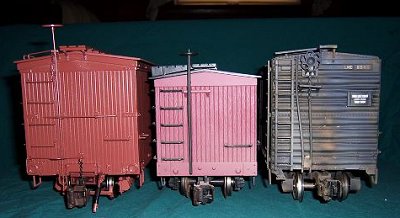 Above: Three popular toy train manufacturer's injection molded boxcars. They all operate on Gauge I track, but represent three different scales and two different prototype track gauges.
|
|
Garden Railroading & Scale Almost all garden railways in North America operate on #1 gauge track (45mm between the rails). Many different prototypes and scales are found among these “large scale” trains; but nearly all of them share one thing in common: They operate on the same gauge of track. Scale and gauge are actually two very different concepts. Scale refers to the proportional relationship between a given model and the prototype it is intended to represent. Gauge, on the other hand, refers to the distance between the rails upon which our models run. |
|
|
One Gauge, Many Scales,
Much Confusion Ideally model trains built to a particular scale should also run on a model track gauge proportional to that of the prototype. Historically, as garden railroading has evolved, this has not been the case. Concern for scale has generally taken a back seat to the expediency of one almost universal track gauge—45mm—and the result has been a cacophony of scales, mismatched models, and confusion, all trundling down the same track under the vague heading of “G” scale. On many garden railroads, one can find models of American standard gauge trains (4’-8½”) operating right alongside 3’ narrow gauge ones, European meter gauge, and even Maine 2’ gauge trains - all on the same track. As many as six different scales (1:32, 1:29, 1:24, 1:22.5, 1:20.3, and 1:13.7) now populate the large scale scene! |
|
.gif) The
F Scale Solution The
F Scale Solution
Historically, full size
railroads in North America have been built to several different
track gauges. Although most of the narrow gauges lines—those
measuring less than 4’-8½” between the rails—have disappeared over
the course of time (as did the “broad” gauges shortly after the
Civil War), in the world of small scale model railroading the narrow
gauges live on alongside their standard gauge counterparts. Unlike
the smaller model railroading scales, where each major scale has its
standard as well as narrow gauge counterparts in the same scale
(for example: O, On3, On30; or HO and HOn3), each scale making use
of several different, proportional track gauges, large scale has not
had this option . . . until now. Over the
last decade the major commercial manufacturers of large scale trains
have tended to coalesce around modeling either standard gauge
prototypes in 1:29 and 1:32 scales or 3 foot narrow gauge ones (such
as the D&RGW, Rio Grande Southern, and East Broad Top) in
1:20.3—what the National Model Railroad Association (NMRA)
designates “F” scale. At 15mm=1 foot, or worked out as a proportion,
1:20.32, F scale most accurately represents 3 foot gauge prototypes
operating on 45mm gauge track. However, there has remained only one
track gauge—45mm between the rails. That has now changed with the
introduction of F Gauge (aka 1:20.3 Standard
Gauge). To arrive at any actual model dimension in F Scale from a prototype one, simply divide the prototype dimension by 20.32. Or if you prefer to work in the metric system, in F Scale, 15mm = 1 foot. “F,” then, is just shorthand for saying 15mm scale. It’s that simple. |
|
|
F Gauge Product Support
|
|
| Continue on to Wheel & Track Standards . . . | |
|
Last update: 20 August 2013
|
| Copyright 2004-2013 CumberlandModelEngineering.com. All Rights Reserved |

.JPG)
.jpg) As
of the Fall of 2010, several garage based manufacturers and custom
builders are actively supporting F Gauge. Available prod-ucts from
As
of the Fall of 2010, several garage based manufacturers and custom
builders are actively supporting F Gauge. Available prod-ucts from
.jpg)