"Your source for standard gauge modeling in 1:20.3"

The CME Pages

The Gauge 3 Galleries

The F Gauge Galleries

Links

Home


C
ME News (From the world of 1:20.3 Standard Gauge or What Dave is Up To)

Cumberland Model Engineering Is Back!

The biggest news for me and my family in 2010 was the resumption and expansion of my model making business. Since beginning work as the pastor of a small church plant here in Knoxville (St. Paul Presbyterian) which requires me to be bi-vocational, I now have time and incentive for once again taking on custom model work, allowing me about 3-4 days a week in the shop. My shop's equipment has also grown correspondingly so that I am now equipped to do CNC milling and laser cutting of both wood & styrene as well as wire EDM cutting of metal, manual milling and turning. Short-run production work on a Monarch 10EE turret lathe is also now possible. More information is available on the workshop page as to my shop's history and capabilities.

The News Page is intended to keep other F scale enthusiasts informed of my progress on both my own models as well as those of friends' and clients with whom I am corroborating. Some of my customers will recognize their projects here--others will see what progress I have made on patterns for future commercial offerings related to my own projects. But don't expect a weekly update. I'd rather be building trains--or as is more often the case--playing with my three girls and their little brother!

I'm always happy to field your questions or just to talk trains. Drop me a note at DavidQueener@juno dot com

Cheers!--Dave


(A one year old Shop Boy makes a visit to Daddy's hideout; "Uncle" Don watches)

D&RGW L-105 4-6-6-4 Progress (updated 11-28-11)

Much of October I spent working on parts for Doug Hemmeter's D&RGW L-105 Challenger. Here are some of the results.

•  Lead Engine Unit CAD drawings  The L-105 was an early recipient of integrally cast cylinders, frames and valve gear supports. These massive steel castings were a honeycomb of pockets, undercuts and cores. Designed to maximize frame strength and overcome one of the chief maintenance headaches common to built up frames, integrally cast frames overcame the natural tendency of bolted together ones to work themselves lose due to vibration. Out of tram frames mean binds, hot bearings, and worn bearing surfaces. From a modeler's standpoint, cast integral frames are difficult to reproduce due to their many cut outs and undercuts. Even at that, most of the components will never be seen, so some degree of simplification is necessary. My design work on the lead engine unit for the L-105 reflects this reality. Starting with the prototype frame drawing, I first reproduced the lead engine unit in all its complex glory and then sought to simplify the model version from it. The image from my CAD drawing at right is that of the prototype without allowances for the model. A PDF version scaled to 1:20.32 and printable on size E paper (36x48) may be viewed here.

•  Main & Side Rods--The Japax wire EDM was kept hot this past month producing the four main rods, front side rods, and four back side rods for the L-105. These were cut on two sides from 1" square brass bar and are not casting patterns but actual production rods. One of the lessons learned here is that it is more economical to make a casting pattern for each rod on the wire EDM rather than to burn every one individually since only about 4¾ hours programming time was required for the three different rods but 36¼ hours were necessary for cutting all 12 production ones. Nevertheless, I am pleased with the results, and here are a few thumbnail pics of the results. Some milling remains, namely for the fluting on the main rods.

•  Machining Drivers and Axles--Doug had some leftover driver centers from the M-68 project which had been partially machined by the late Doug Cockerham. These Baldwin disc drivers were the original impetus to building an L-105 Challenger. These drivers were originally intended for 73" OD tyres, but we are shaving them down to be compatible with the L-105's 70" drivers. Tyres are made be me with a bit of modification, namely the cutting of a new tread profile, same as we have used on our wheelsets and for which Gary Watkins of Sierra Valley Enterprises deserved credit (these are his third generation of tread profile which works well indoors and out, with an approximately .074" flange height). I produce tread on tyres and wheels by plunge cutting a specially formed 1/2" square M-2 Cobalt steel lathe tool directly into a plain tyre ring or wheel disc. Taking the cut slow and easy, the results are satisfactory.

In addition, since this locomotive will be using four gearboxes provided by Barry Olsen of Barry's Big Trains, (thumbnail at right) which uses a ¼" shaft with a flat on it, I made a dozen stainless steel axles. The set up was pretty straight forward: Cut off, grind to length, place into a fixture in the mill, and mill the 1/8" x 1" flat onto the center of the axle. Here's a few pics of this set up as well:

Doug Hemmeter Finishes Second D&RGW M-68 4-8-4
(And Nears Completion on Two Others!) (updated 11-30-11)

Doug Hemmeter has been at work on four models of the D&RGW M-68 4-8-4 since about 2006. The first locomotive, #1801, was finished in August of 2009. The second, #1804, in D&RGW black livery, was completed in April of 2011. The two other M-68 Northerns, #1802 and #1803, are in the super-detailing stage and should be done by early 2012. Here's some pics of both 1804 and the remaining two locomotives. Additional photos can be found in Doug's Gallery

1:20.3 Standard Gauge Radius Test (updated 8-28-11)

One of the quandaries that arises when developing a new scale and track gauge is determining what minimum radius various steam locomotives can be designed to traverse and how to do it. Model locomotives are expected to negotiate minimum radius curves proportionally far tighter than their full size counterparts. For instance, if we project up from the smaller scales, a 36" minimum radius in HO scale would be considered quite generous, in fact a necessity for many 10 coupled or mallet articulated locomotive. In F scale, 13 foot minimum radius would be the rough equivalent to 36" minimum radius in HO scale. The engineering question, however, is how to get there. For a Big Boy in F scale or a Santa Fe 5011 series 2-10-4, 13' radius sounds pretty tight. When looking at the layout of that many drivers in a rigid wheelbase, especially larger diameter ones in the 70" to 80" range, then things begin to look almost impossible. Little Engines Gauge 3 live steam 4-8-4s, for example, required a 20' minimum radius. So the question is how can a large scale model be built proportionally to do what a small scale model does, without looking silly or introducing gross compromises.

Two tricks are available to make a scale model go around non-prototypical curves (1) Use flangeless or "blind" drivers on the middle axes of long wheelbase locomotives and/or (2) increase the lateral travel or side-to-side-play among the several drivers. The latter technique often requires kicking out the cylinder centerlines on most models and making sure there is enough slop between the side rods and the crankpins they ride on to avoid binds. This is a very useful technique and it has been used to good advantage in Fn3 on the Berlyn Locomotive Works D&RGW K-37 Mikado. Lateral play is over 1/4" for each driver. Both lead and trailing trucks are also designed to swing far beyond their prototype counterparts (see below and thumbnails at right). According to Theo Berlyn, his Korean built K-37 is capable of snaking around a 6' minimum radius curve!

Engineering the L-105

On the the D&RGW L-105 4-6-6-4 (see announcement below) whose chassis I am building for Doug Hemmeter and Gary Bartlow, my goal is to engineer this portion of the locomotive to get around at least a 13' radius curve, maybe even a 10' one. Towards that end I have laid out several test curves on my work bench (above) and begun doing some of the engineering work first in AutoCAD. At this point, my best guess is that 1/8" of lateral play will be required in drivers #2 and #5. Mounting the boiler at two pivot points above each engine unit, in the style of a Garratt rather than a mallet articulated locomotive, will also be needed to enable this massive six foot long model to negotiate so narrow a curve--and not look silly in the process. Remember, these big F scale models are being built to run, not just sit on a shelf and look pretty. Further engineering and developmental work is being done on on one of my own models (below).

Brass 2-8-0 Frame Takes Shape (updated 8-30-11)

Before I cut metal for the L-105 frame, however, I want to test this amount of play on some of my own equipment; and towards that end, I have once again been at work on my Southern Railway G class 2-8-0 chassis, the rigid wheelbase of the two locomotives being comparable. Though I have milled several stainless steel frames for this same 2-8-0 before with decent results, this time around the frame is entirely cut from brass bar stock on my Japax wire EDM, enabling me to add several tabs and cutouts for locating frame spreaders, valve gear and boiler supports. I've used 3/16" thick bar stock for the frames halves themselves (pretty close to a scale 4" as per the prototype).  By way of comparison, the Berlyn K-37 above uses 1/8" thick brass plate for its frame halves. Frame spreaders are cut from 1/8" plate and from several other sizes. Bearing boxes are also wire EDM cut but are then drilled and reamed to accept 8mm ID ball bearings.  Drivers centers come from two sources: (1) Most are investment cast copies of Palacina Productions 2.5" OD die cast drivers which have been modified by soldering on new brass crankpin hubs and counterweights; (2) The #3 drivers with their heavy crescent counterweights are castings made from wax patterns carved by Mr. Bill Zingheim (Bill is a former dental lab technician, business owner and live steamer). New 50" driver tires have also been made manually on my Monarch 10EE lathe using a special tread profile form cutting tooling which I made from cobalt steel on the wire EDM. Propulsion for this model will be a Pittman 24 volt DC gear head motor driving an Accucraft 1:1 ratio helical gear box from one of their K-28s (FYI-Accucraft appears to use 8mm axles on most of their large scale products). If all goes well, down the road this will be the prototype for a locomotive kit.

Driver Machining (updated 8-31-11)

My Monarch 10EE lathe and Bridgeport style mill have been getting a workout of late. Over the last few weeks I have been machining driver castings, modifying Palacina Productions die cast drivers, and turning new steel tyres for several projects. Having a six-jaw Set-Tru chuck on my lathe and a DRO (digital read out) on my mill has made all the difference it terms of accuracy compared to my previous attempts at machining drivers (back in the days of a mill-drill and a Harbor Freight Chinese-made 7x10 lathe-see thumbnail at right)!

•  Manually Turned Steel Driver Tyres  To arrive at the various sizes of drivers that I need for current projects, I have both modified steel tyres I had on hand and turned several new ones from slices of DOM ("drawn over mandrel") steel tube. Once "faced" on both sides and turned to the approximate OD, each steel ring is chucked up in the "soft jaws" of my Set-Tru chuck and then bored to the proper inside diameter--accounting for .001" interference on the radius for a press fit with a white bronze driver center wrapped with a .0033" thick strip of Mylar to serve as an insulator. The tread of each tyre is then formed by plunge cutting on the lathe, using a specially shaped form cutting tool. Tread profile form tools are commercially available in O scale for Proto:48 (from Proto-Craft); but in F scale, I had to make my own of course. With the right tools, it's not all that hard to do. Basically the wheel tread is drawn in CAD, and then that profile is cut using a wire EDM, the wire of the EDM burning the mirror image of the tread's profile into the end of a length of tool steel (cobalt or HSS).

For those of you just itching to turn your own wheels and tyres, and you have a rigid enough lathe, these same 1/2" square profile tools are available upon special order.

•  50" Drivers for Southern Railway G-Class 2-8-0--The Southern Railway G-Class 2-8-0 was essentially a catch-all category for a number of pre-merger 20x24 slide valve consolidations inherited by the Southern from predecessor roads. One has been restored to operation just this past year (2010): SR 154 (whose drivers you see at right). In 2001 I began work on what I hoped would be the pilot model for a F scale kit of this small drivered locomotive (you can read more about that here). That project was put on hold for awhile during my previous pastorate; but with the D&RGW L-105 project in high gear, the need for a viable test chassis has jump started the project

Back in 2001, the quest for appropriate drivers for this locomotive lead me first to a course at technical college in CAD and CNC machining, then to a  retired dental lab owner and pattern maker (Mr. Bill Zingheim), and now back again to the prospect of adapting some investment cast copies of a Palacina Productions 2½" OD driver which my friend Barry Bogs was initially going to use on his Denver & Salt Lake 2-6-6-0 in Gauge 3. But Bill Zingheim deserves credit for the first foray down this road. Bill is a model railroader and micro-manufacturer, serving the live steam phase of the hobby with 7½" gauge plastic cross ties, custom built turnouts & cross bucks, but he is also a skilled pattern maker. Bill hand carved wax patterns for both the crescent and the block counterweighted driver centers on the G-Class 2-8-0 (thumbnails above). Bill's pattern work produced a viable crescent counterweight driver (right); but sadly, his original pattern for the block counterweighted driver did not burn out effectively. And so when the time came for a quick solution to my need for drivers for the 2-8-0 frames (above), I turned to the 14 copies of the Palacina Productions 2½" OD driver center which Barry Bogs had given me (first pic at left below) as well as Bill's remaining driver castings.

And so the 14 copies of the Palacina Driver center are now being modified to approximate the block counterweight G-Class driver. The Palacina copies are first turned down on a specially made mandrel (since they have no cast-on-lug in the back for grasping with either a collet or a six-jaw chuck. Next new brass counterweights and crankpin hubs are soldered on. Finally, the crankpin and axle holes are drilled and reamed for each driver center in a rotary table on my Bridgeport type mill. The last pic above is a comparison of the Palacina copy, a reworked center, and an ABS rapid prototype of the G-class driver center based upon a SolidWorks 3D CAD drawing. Ultimately a new casting pattern will be CNC machined in accordance with the SolidWorks 3D model--maybe even production ones will be made this way.

•  44" Drivers for Baldwin Logging 2-6-2--In the late 1990s a man by the name of Ed Silveira from Thousand Oaks, California began marketing a line of die cast replacement drivers under the name of Palacina Productions. They were meant to aid kitbashers and scratch builders who were then modifying Bachman Big Hauler 4-6-0s as well as Aristo-Craft pacific mechanisms. I would up with several dozen in an assortment of sizes (2", 2¼" and 2½" OD). A number of the 2¼" drivers found there way onto Gauge 3 2-4-4-2 mechanisms, replacing the LGB Stainz drivers of their respective motor blocks. The remaining six I am now using on a customer project. Mr. Aaron Rohyans, who hails from Indiana, is the newest convert to 1:20.3 standard gauge, and he wants to build a model of White Water Valley (formerly Alger-Sullivan Lumber Co., formerly Florala Saw Mill) 2-6-2 #100. Aaron has asked me to create a chassis for both the tender and the locomotive. He will do the rest. So the last of the Palacina drivers has now found a home, but only with extensive modifications. These include turning off the old counterweights and crankpin hub, the addition of new brass ones which are soldered on, and the application of separate 44" steel tyres with mylar insulation between driver center and tyre. For anyone else trying to modify die cast drivers, one word of caution: Die cast alloys readily melt under the heat of a propane torch! Use caution. Palacina originals are pictured are far left with additional wire EDM cut brass shims at middle, followed by pics of my special arbor for holding the drivers and then a few pics of the soldered driver center.

•  70" Drivers for D&RGW L-105 4-6-6-4--Following the completion of the chassis for his four (yes, that's right--four!) D&RGW M-68 4-8-4s,  Doug Hemmeter had 13 driver castings left over, enough for one D&RGW L-105 4-6-6-4 plus a spare. The M-68 and the L-105 were built at about the same time by Baldwin and shared a number of interchangeable components. Their drivers were nearly so, the M-68 using a 73" version of the unique Baldwin disc design whereas the L-105 had a 70" version. Some of Doug's drivers were partially machined by the late Doug Cockerham. I am now completing the job with my own 70" steel tyres, crankpins, 8mm axles, and quartering jigs. More pics to follow.

30 Ton Archbar Truck Update (updated 9-7-11)

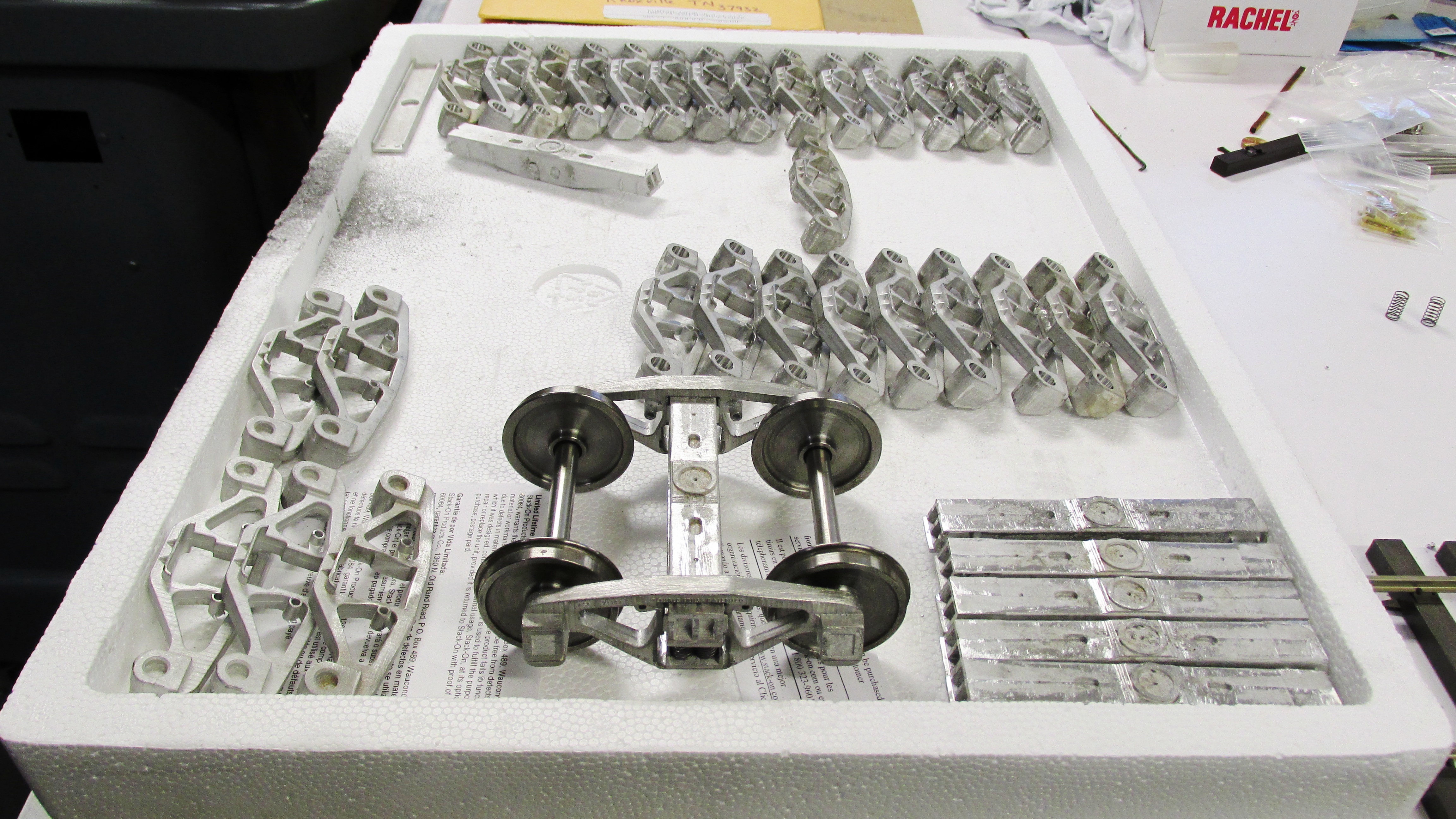
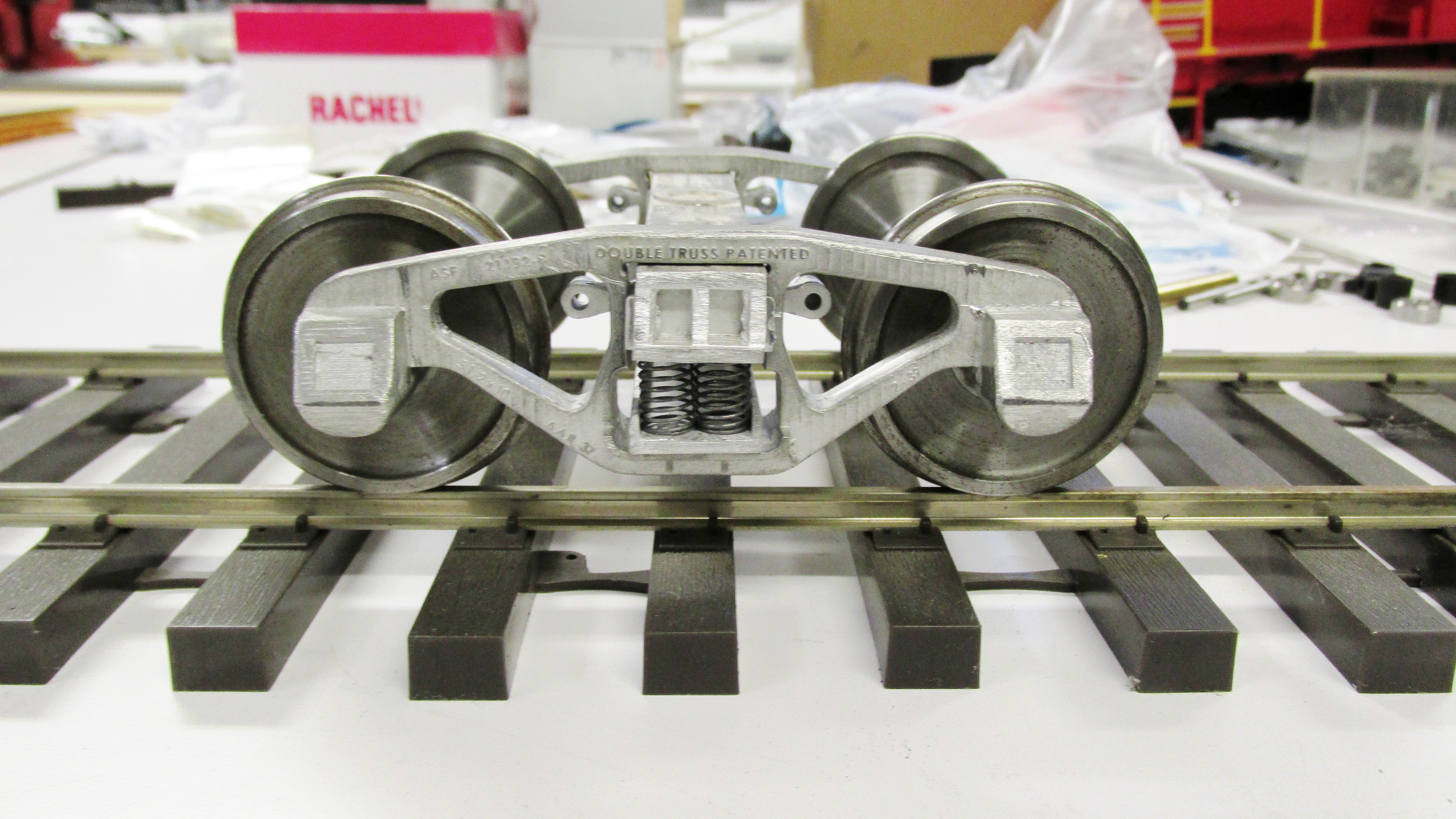
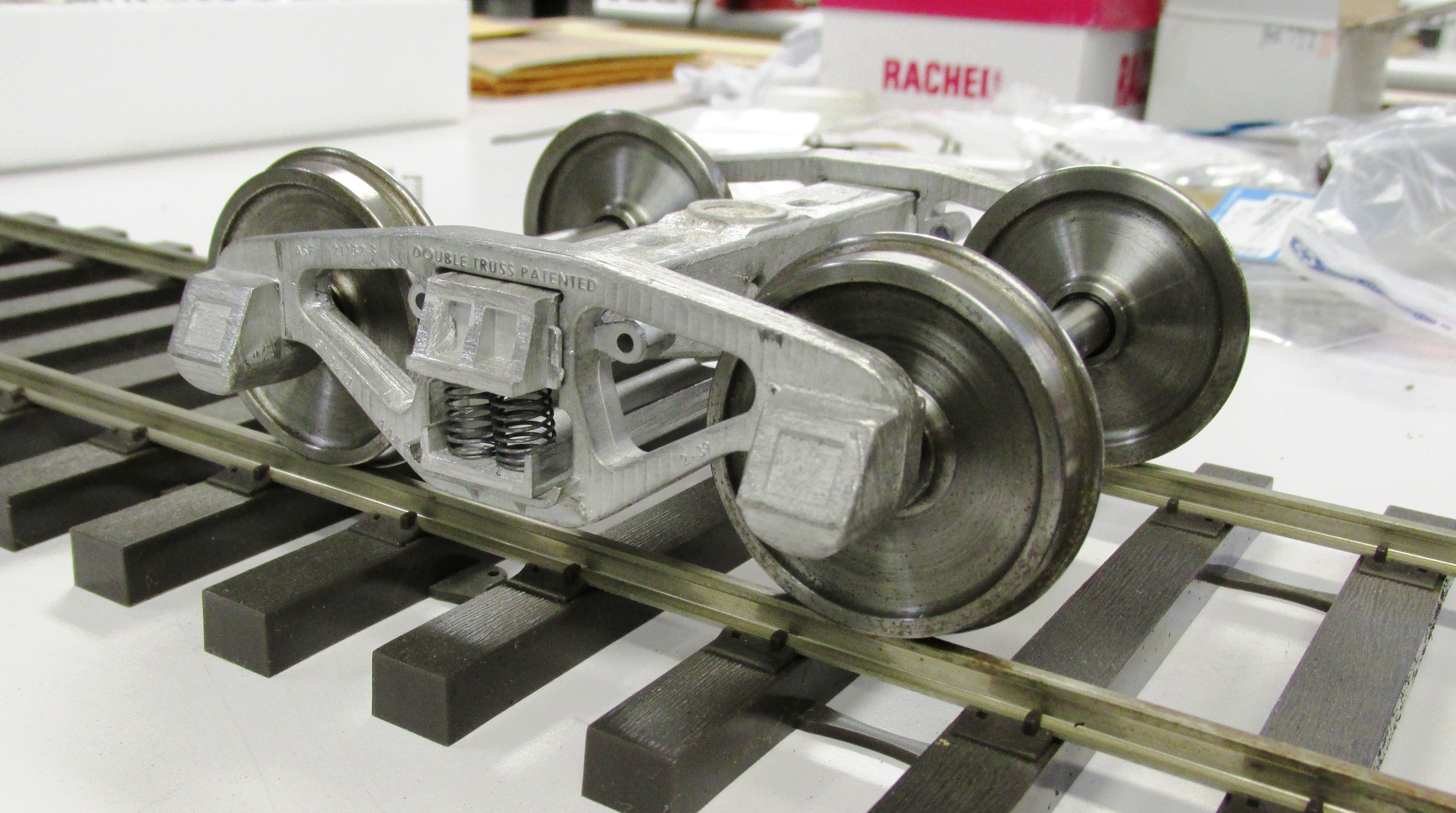
Here's a look at the progress I have made in pattern making for the 30 ton archbar trucks introduced below. These are being made 2% oversize with the specific goal of casting them in white metal (rather than the 4% oversize ones below which are being made for investment cast brass). Don Niday will be marketing these as part of his Iron Creek Shops product line. Bob Hartford will be doing the actual spin casting in his own North Carolina workshop. Remaining work to be done on the patterns include the addition of square head shoulder bolts and nuts, centering plates, "pods" for the truck springs, brake rigging, and soldering of the assembly. Nearly all parts were cut on my Japax wire EDM. Don plans to have the pattern and maybe the first production trucks at the 2011 National Narrow Gauge Convention in Hickory, North Carolina later this month. Most recent pictures show several of the pattern parts soldered together and assembled as of September 7th, 2011.

30 Ton Archbar Truck Casting Patterns (updated 2-23-11)

In 2004 and 2006 my former denomination's presbytery met in Lancaster, Pennsylvania--just a few miles from the Strasburg Railroad and the Railroad Museum of Pennsylvania. Of course, with that many trains and the lure of a Norfolk and Western M-Class "Mollie" being kept hot for the day's run to Paradise, well, what red-blooded steam enthusiast could resist? So after the last session of Presbytery, I hustled down to Strasburg . . . and began taking measurements of the 5'-0" wheelbase 30 Ton archbar trucks that are on the pair of 36' Ma & Pa boxcars. Strasburg is one of the few places that historic, standard gauge wooden freight cars can still be found, and these trucks are exactly what Don Niday and I have been looking for to model for his 36' wooden boxcar kit in F scale.


The casting patterns are made from brass bar stock cut on my wire EDM, including the spring plank and 10" channel truck bolster. The archbars I cut in two ways--as individual bars, and as a a one-piece unibar. Some mill work on the columns, a bit of drilling tapping, and then some soldering of the entire assemblies should get these ready for the foundry. Extra columns were made in case I wipe out a few during milling. More photos will follow my progress.

Shop Progress--The Test Track (updated 2-23-11)

Sundays nights of late have found me out in the workshop listening either to a documentary streamed over Netflix or a book on tape (history and biography are my preferred genres, though Tom Clancy makes an occasional appearance). While listening, I have begun to finally spike down the F & Fn3 test tracks that I have built atop of shelves on the back and the right hand shop walls. These are eye level with me (and I'm 6'-2") so these are well above countertop level. Two #6 dual gauge turnouts are planned as is a #8 dual gauge crossover. The two shelve layouts will be connected by a 10 foot minimum radius curved deck girder bridge which can be raised to the ceiling to clear the soldering work area in the corner of the shop when it is in use. Why 10' min. radius? My goal is to engineer my locomotives to snake through this tight a curve at slow speed. In F scale scale, a 10' minimum radius curve is equivalent to 28" minimum radius in HO scale. Rail is code 332 brass (a mixture of LGB and Aristo-Craft) on the right hand wall, Llagas Creek code 250 nickel silver on the back wall (the single track line). Power is 24 volts DC from a Bridgewerks Magnum.

Shop Progress--With A Little Help From My Friends (updated 2-22-11)

Over the last 6-9 months I have had a great deal of help getting my workshop equipped and running such that I am no longer just trying to get old machinery fixed up, but actually making train parts--finally. More about the specifics will be found here soon. But I owe no small thanks to three men who have done a great deal to make this happen, three men whom I am very pleased to call my friends as well as collaborators.

•  Julian Morrison--is not only himself an accomplished machinist and builder of model engines, but has gone beyond the call of friendship by rebuilding, hauling, and helping install some of these 65 year old machine tools that I use on an almost daily basis. But more than this, he is also a mentor to me in the art of manual machining, having opened his own shop to me and given a great deal of his time to tutor a novice.

•  Don Niday--is not only a fellow F scale modeler, garage manufacturer, scratch-builder and artist with an airbrush, but he is also one of the best trim carpenters around, and may even be more details oriented than I am. Plus, he has built me one of the best rolling storage cabinet / worktables a man could want! And now he is learning AutoCAD to boot!

•  Jeff Nichols--is one of my parishioners, but oddly enough not a model railroader!!  He is a first rate mathematician, expert networker, and computer diagnostician. As a teenager in the 1980s Jeff was building his own computers. By the 90s he became the first IT guy for Jewelry Television (and was self-taught when the acronym IT did not even exist, let alone a department to teach you how to become one!). But he has very graciously set up the network which allows my computers and CNC equipment to talk to each other and helped out with several other grunt shop chores. I hope the trains will come too, in time.

Mr. Julian Morrison
Master Machinist & Metal-cutting Mentor


Mr. Don Niday
Model Railroader, Craftsman & Artist

Dr. Jeff Nichols, PhD
IT Whiz & Computer Guru
(and one of the world's great eaters)

L-105 Lead Truck Completed (updated 2-22-11)

The first order of business in my work on the D&RGW L-105 project has been to complete the Baldwin designed lead truck. This same lead truck was, like the trailing truck and tender, also used on the M-68 4-8-4, the two classes of locomotive being purpose built by Baldwin to have many interchangeable parts. Since I did not have part drawings of the L-105 lead truck--only the elevation and section drawings--about 25 hours of CAD work were required to trace and guesstimate the truck's design. 115 man-hours of machining and assembly work later, the first truck was finished by me (Dave) in mid-January. This is only the second 4-wheel lead truck that I have built, the first being a somewhat stiff affair I filed in 2001 from brass bits and pieces for a model of Little River Lumber Co. baby pacific #110 (inset above). By contrast, the L-105 lead truck is sprung, equalized, and features a spring-loaded centering device. Heart-shaped rockers for the centering device were deemed too fiddly for a rugged outdoor, operating model.


Most of the brass parts were cut on my Japax wire EDM with a bit of additional mill work done on a Bridgeport clone. 36" lead truck wheels were supplied by Bill Brisko of Pacific Locomotive Works. Bushings and axles were made on my Monarch 10EE turret lathe. I'm confident that if I had it to do it over again, I would make the frame and centering components as casting patterns, and then have additional copies shell cast, which would greatly amortize the cost of so much machine work. Even so, I'm pleased with the results. My thanks go to Capt. Tom Mix (USMC, Retired) and master-modelmaker Kelley Morris for their suggestions, insight and superb examples from the smaller scales.

Barry Bogs Finishes 1st UP Centipede Tender (updated 12-31-10)

As has been detailed on earlier updates below, Barry Bogs was tapped in mid-2010 to build the 5 centipede tenders for the UP Big Boy / Challenger project coordinated by Doug Hemmeter and commissioned by Gary Barlow. Barry has sent in a steady stream of photos as he has gone from styrene master patterns to production uerthane castings and then completed and painted models. Here are the results thus far:


Doug Hemmeter at the Houston Big Train Show (updated 12-31-10)

My friend and the driving force behind the UP Challenger / Big Boy project in F scale, Mr. Doug Hemmeter (also known as D&M Railroad Backshop), displayed two of his D&RGW M-68 4-8-4s along with an Fn3 C-25 and the first of the Big Boy / Challenger tenders cast in urethane by our mutual friend Barry Bogs. Additional pics of Barry's tender can be found on the UP Challenger / Big Boy page). At the show many children and their parents were drawn to these massive models--as well as to the stunning sound which emanates from their boilers (that's right--their boilers--since in F Gauge a locomotive boiler is easily 3.5" in OD, providing amply room for a substantially sized 8 ohm speaker--that in addition to any speakers cared by the tender). Doug's M-68s are placed upon roller displays for operation at shows, since as of yet, no one has created F Track--the modular railroad for standard gauge modeling in 1:20.3 (any takers out there?).

30th National Narrow Gauge Convention
(updated 12-31-10)

The last time I was an exhibitor at a major train show it was 2001 when my friend Don Niday and I displayed our three newly built dual gauge (F & Fn3) modules at the National Train Show in St. Louis--part of the NMRA's national convention that year (see inset pic). Don has since been an exhibitor several times over, but I have pretty much stayed on the sidelines due to time constraints. Now that I am bi-vocational once again and able to get trains out the door, I have the distinct pleasure of attending shows--and to enjoying the delights of meeting and chatting with fellow model railroaders. This September 1-4, I traveled to St. Charles, Missouri, just northwest of St. Louis, and was joined by Mr. Doug Hemmeter and his wife Mary (above), where we displaying both standard and narrow gauge models in F scale, including several of Doug's M-68 4-8-4s. One of the original modules made it to St. Charles after a bit of refurbishment by my wife and kids. Several other modelers in F Gauge stopped by (including Ric Golding with his own kitbashed 40' flat car!). Most impressive to Doug and I was the Fn3 Sundance Central modular layout. Now if we can only get them to add a dual gauge yard and a standard gauge interchange!

Take the Big Boy Challenge! (updated 1-1-11)

I was stunned when the announcement came this past Spring--Doug Hemmeter had been commissioned by Mr. Gary Bartlow to build not one but three late model UP Challengers. And then I was stunned a second time to learn that not only would three Challengers be built, but three UP Big Boy 4-8-8-4s would also be in the offing. Since then Gary and Doug have agreed that one of the Challengers will in fact be not a UP model, but the D&RGW's Baldwin-built L-105 4-6-6-4, that locomotive having shared a goodly number of parts with the D&RGW M-68 4-8-4 (compare UP 3985 with the L-105 above in B&W).

These six locomotives are being built as a corroborative effort; and when complete, at least several of them will be for sale. My commission is to construct the brass and steel running gear for all six locomotives since my shop now has every machine tool a serious model builder could want (save for a CNC lathe). Barry Bogs is building the centipede tenders from styrene masters and urethane castings. Doug Hemmeter is constructing the boiler shells from brass, the cabs from styrene, and doing all the final detail and assembly work. Bill Brisko is providing the driver center castings, 36" and 42" wheels. In addition to Bill's 3D CAD and rapid prototype work on the drivers, various other complex detail parts are being created either by myself or a helper as 3D CAD drawings in Autodesk Inventor and then rapid prototyped in ABS.

In the weeks to come, I will be creating a separate page for chronicling this massive project. In the meantime see Barry Bogs' work above.

Mallet Meets Northern (updated 8-20-10)

In January of 2010 Doug Hemmeter delivered the first of four F scale standard gauge D&RGW M-68 Northerns to Mr. Gary Bartlow in southern California. Doug and Gary were joined by Mr. George Konrad and his recently completed F scale Denver & Salt Lake vest pocket mallet. Doug also brought along one of the chassis from the three additional Northerns he is constructing. One can still be yours, if the price is right! That's Doug in the blue shirt, Gary in the orange stripes, George in the background in a denim jacket.

D&RGW 40 Ton Andrews Truck Project (updated 8-20-10)

For some time now only two freight car trucks have been available in 1:20.3 standard gauge (a long wheelbase archbar truck and a cast urethane Bettendorf style truck, both marketed by my friend Don Niday--see the Products Page. In the next few months I plan to offer a first in 1:20.3 SG: an investment cast brass Andrews truck. I've have described the prototype briefly on both the Products Page and on Dave's Freight Cars, so I will not repeat that information here. What is worth knowing is the progress that has been made on this truck over the last several months and the way this progress has come about.

Although the Andrews concept of a cast steel frame with bolt-on journal boxes dates from the 1890s, I was unable to find any drawings for the early Andrews T-Section design, and in particular the version used by the D&RGW. Enter fellow large scale modelers Rick Blanchard and Kevin Strong. Each of them provided me with invaluable measurements and photographs of the two pairs of these trucks which remain on D&RGW dual gauge idler cars X-3050 and 010793, located at the Colorado Railroad Museum at Golden and at Antonito, Colorado, respectively. From their measurements I worked up 2D CAD drawings for the 5x9 journal boxes, truck side frame, truck bolster, body bolster, McCord journal box lids, and journals box bolts.

The 3D CAD Model

Initially, a third party turned my 2D side frame and journal boxes into a 3D CAD model using SolidWorks (pictured at right). Sometime in February of 2008 I was contacted by a Swiss modelmaker, Mr. Steve Weber, who had found my site on account of its emphasis upon Gauge 3 (Steve builds high-end commercial models of German and Swiss prototypes in Gauge 3, known as Spur II on the continent). The rapid prototype wax which Steve produced was subsequently turned into a brass pattern by O scale model railroad and back-yard-foundry man Dennis Mashburn of Abilene, Texas. You can see more of Steve's excellent work elsewhere on this site and on his own.


Last update: 23 February 2011

Hit Counter